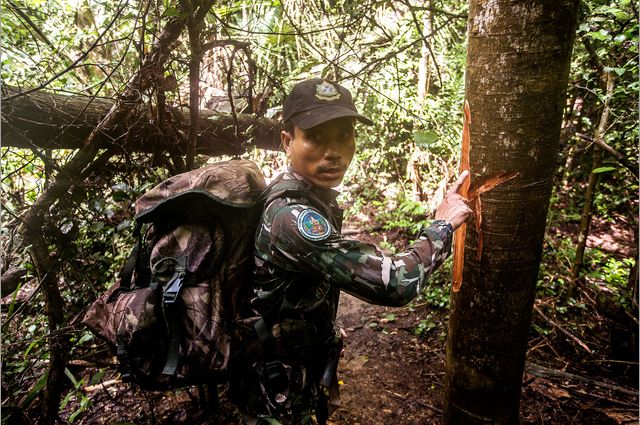
The rangers were slogging their way up the mud-slick mountainside in Thap Lan National Park when a hand signal brought our patrol to a sharp halt. A scout up ahead had found a letter “K” carved into the side of a tree. It was the signature of a timber poacher, rumored to be Cambodian, who had evaded capture for months, taunting them each time he pushed deeper into protected Thai territory.
Captain Morokot and his scout rushed forward hoping to catch the loggers by surprise, only to find a makeshift abandoned camp. Red Bull energy drink cans and cigarette butts littered the ground.
“The poachers have their own lookouts, so it’s getting harder to sneak up on them,” Morokot sighed. “We know some of them were soldiers [because] when we get close, they have no problem shooting at us.”
In the mountain jungles of eastern Thailand, a shadowy war is ramping up between poachers and the ill-equipped rangers tasked with stopping them. Surging Chinese demand for so-called “red timbers”—Tamalan, Padauk, Siamese rosewood—has fueled the destruction of forests across Southeast Asia’s backcountry and now threatens to drive some tree species to extinction.
ENLARGE
Captain Morokot, a ranger in Thailand’s Thap Lan National Park, hunts for signs of timber poachers. Many of them target valuable Siamese rosewood.PHOTOGRAPH BY JASON MOTLAGH
Thap Lan and adjoining parks—part of a complex that has UNESCO World Heritage status—are home to everything from black bears and crocodiles to elephants and tigers. Nearly 150 bird species have been documented in Thap Lan alone, including the green imperial pigeon and stork-billed kingfisher. By cutting down trees and hunting for bush meat, timber thieves are threatening one of the most biodiverse corners of Asia.
Linked to multinational criminal syndicates that have systematically clear-cut swathes of neighboring Cambodia, the logging gangs operating in Thailand are well armed, coordinated, and prepared to kill. In 2014, seven Thai rangers died in gun battles with illegal loggers. Two more were killed in a late-night ambush following a November raid on an illegal logging site.
“These trees belong to our people,” said Morokot, who first came to Thap Lan as a tourist and was so moved by the richness of the place that he applied for a job to protect it. Now he’s one of dozens of rangers who patrol the 860-square-mile (2,235 square kilometers) reserve, teams so ill-equipped that some men don’t even have guns, and bullets are always in short supply.
As timber elsewhere in Thailand runs out, loggers are making more brazen incursions deep into Thap Lan to steal the most prized timber of all: Siamese rosewood. With its darkly rich hues, density, and fine grain, rosewood has long been a favorite in China, where it’s carved into elaborate furniture and religious statues known as hongmu, an antique style that originated centuries ago.
Reproduction hongmu furniture has become a status symbol of China’s new rich. A 2011 report by the Environmental Investigation Agency, a U.K.-based NGO, says demand for Ming and Qing dynasty-era replica products soared in the run-up to the Beijing Olympics in 2008 and has stayed high. Prices hover around $20,000 a ton, with some varietiesspiking as high as $80,000.
A smaller, but significant, amount of illegally harvested rosewood makes its way from Southeast Asia via China to the U.S. These exports range from hongmu items sold in Asian furniture emporiums to name brand mail-order coffee tables.
ENLARGE
Protecting trees is a dangerous job for ill-equipped Thai rangers, who lack sufficient guns and bullets to defend themselves against brazen poachers.PHOTOGRAPH BY JASON MOTLAGH
“For the last two or three years, it’s just grown out of control,” says Tim Redford, of the Freeland Foundation, an organization funded by the U.S. government that monitors wildlife and trains rangers to combat rosewood poachers. “They’re going in with AK-47s, M-16s, hand grenades detonators.” As rosewood becomes scarcer, he adds, the risks the timber thieves are willing to take are increasing.
“What most consumers don’t understand in America is that this wood came from an illegal source,” says Redford, who acknowledges the difficulty of tracing a product’s origins. “People have risked their lives for that timber.”
Poachers Without Borders
In Thailand, Laos, and Myanmar massive tracts of virgin forest have been razed to sustain the rosewood trade, but no country has lost more than Cambodia. By some estimates, more than a third of its forests disappeared during the past four decades, despite a moratorium on logging and a 2013 ban on the harvesting, sale, and export of Siamese rosewood.
In Cambodia, poverty drives many men to timber poaching. One veteran smuggler, who declined to give his name, said he logged rosewood on the Cambodian side for years until the trees ran out. (We were introduced by a local journalist, and he agreed to talk because he was frustrated over the lack of economic opportunities in Cambodia.) Then, under cover of darkness, he began making forays into Thailand, hacking down trunks and selling whatever planks he managed to haul out to army soldiers.
A land mine blew off half of his right leg, but with no other way to earn a living, he still crosses the border to search for rosewood, at times taking fire from Thai rangers. “Everybody knows it’s a dangerous job,” he said, “but there’s no choice.”
Although Thap Lan rangers haven’t taken any casualties, Wichai Pomleesansumon, the park’s superintendent, says Cambodian poachers operating inside Thailand have been helped out with arms and logistics support from members of the Cambodian military.
ENLARGE
Valuable “red timber” planks await export in a Cambodian warehouse. Soaring Chinese and U.S. demand for the wood feeds the illicit trade. PHOTOGRAPH BY JASON MOTLAGH
“A few years back, our rangers were finding Cambodian soldiers’ cards left in the jungle, which led us to believe they were the ones doing the logging,” he said. “Now it appears they’re hiring out labor to log for them.” (Cambodia’s military command didn’t respond to requests for comment, but authorities have arrested some soldiers for poaching.)
Freeland’s Redford says that stolen wood smuggled on the backs of amphetamine-addled workers or packed in secret truck compartments makes its way to private depots run by a politically connected timber mafia, where it’s mixed in with domestically harvested timber. Paperwork is then issued for export, mainly to China.
“Daylight Robbery”
Ouch Leng, an independent Cambodian investigator who tracks the illicit rosewood trade, says the Cambodian government has bent its own rules to accommodate timber tycoons who in turn provide hefty kickbacks. The first strategy is for officials to grant land concessions, nominally for agriculture purposes, that allow timber to be clear-cut and sold in the process.
The second is to convert state public property to private property under the pretext of using it for development. Here again, timber is razed and sold off by the companies. “The country is for sale,” Ouch Leng said.
According to Global Witness, a U.K.-based nonprofit that tracks resource exploitation, a timber tycoon named Try Pheap is “at the helm of an illegal logging network that relies on the complicity of officials from government, the military, police and customs to clear rare trees like Siamese Rosewood, traffic logs across the country and load them onto boats bound for Hong Kong” in what amounts to “daylight robbery.” This includes the exclusive right to buy timber seized by any enforcement agencies
ENLARGE
Rangers in Thap Lan National Park search for traces of illegal loggers, who’ve become increasingly organized.PHOTOGRAPH BY JASON MOTLAGH
A February 2015 report alleges that Pheap and his companies have grown rich with illicit logging profits thanks to close ties with Prime Minister Hun Sen, for whom he once served as a personal adviser. Pheap has donated tens of thousand of dollars to the ruling party and holds a royally conferred honorific title—oknha—as a result.
Based on the findings of an unpublished 2012 investigation by an international environmental group, the Phnom Penh Post alleged thatPheap made some $220 million trafficking illegally logged rosewood during a recent three-year period.
Last month, Pheap was singled out again when a provincial governor told officials gathered at the first meeting of a new anti-logging task force that Pheap had been granted illegal concessions on property inside a wildlife sanctuary—land previously confiscated from companies that had violated the law.
Local journalists and investigators who cover logging say they face death threats and have lived in constant fear since the 2012 murder of Chut Wutty, a prominent activist who helped expose a government sell-off of national parkland. He was shot dead by military police. “No one can do anything against the timber mafia because it belongs to Try Pheap,” Ouch Leng said. “He’s the rosewood king.”
Prak Vuthy, a Try Pheap Group spokesman, dismissed the allegations.“Maybe all of these accusations are not true,” he said, adding that his boss has operated his businesses within the law, with official paperwork to back it up.
ENLARGE
Workers in China’s Fujian Province craft furniture made from rosewood, long favored for its darkly rich hues, density, and fine grain. PHOTOGRAPH BY WEI PEIQUAN, XINHUA/CORBIS
Pheap is secretive and avoids interviews, but a museum he’s putting up on the outskirts of Phnom Penh offers a vivid illustration of his wealth and priorities. Made almost entirely out of wood, it rises several stories atop columns of giant rosewood trunks, with a vaulted tile roof and ornate hand-carved molding—a temple to an allegedly tainted fortune.
In a separate complex behind the museum, a large anteroom full of polished rosewood furniture—king-size beds, thrones, busts of Khmer kings—opens up to a warehouse stacked high with raw planks of red timber. At first Vuthy denied that any of it was rosewood, calling it “ordinary wood.” But when pressed, he conceded that some was rosewood, handing over documents with Cambodian forestry department stamps confirming its legal provenance.
The museum is supposed to open this year, but Try Pheap’s staff says it may be delayed by a shortage of large rosewood trunks.
“Buying More Time”
Some of the last virgin rosewood tracts lie just across the Cambodian border in Thailand. Park authorities in Thap Lan confirmed that poachers are coming across in unprecedented numbers, gauged by the volume of arrests and numbers of poachers recorded by camera traps.
On the third day of Morokot’s mountain patrol in Thap Lan park, slowed by driving monsoon rains, his scout spotted another “K” carved into a tree. The red hue of the cut indicated it was fresh. Their nemesis might be at hand.
Once again, the two men charged ahead in pursuit, with rifles at the ready. They slashed through thorny vines and razor-edged palm leaves the loggers had cut down to slow their advance until a river cut them off.
Had the poachers walked upstream, then doubled back in the direction the rangers had just come from? Or had they crossed to the opposite side? Perhaps just one poacher had crossed, as a diversion, while the others double backed up the river.
With the trail going cold, and unsure of which way to go, the rangers stuck to their planned route alongside the river, which eventually brought them to a dirt track: the end of another patrol. Dog tired and empty-handed, they were demoralized.
At this rate of destruction, Morokot reckoned, all the rosewood trees in Thap Lan would disappear. “Right now we’re just buying more time,” he said.
By Jason Motlagh
Wildlife watch
PUBLISHED
Jason Motlagh is a multimedia journalist and filmmaker. He has won a National Magazine Award for News Reporting and has been a finalist in the reporting category. Follow him on his website and on Twitter.
Samuel Nnah Ndobe Indigenous hunter-gatherers of the Congo Basin in Central Africa rely on the rainforest for their livelihood.
“One does not sell the earth upon which the people walk.”
The quote is attributed to Crazy Horse in the late 19th century, as he fought to keep the federal government off the land his Sioux ancestors had been living in for generations. A war that centuries of indigenous populations across the globe before and after him have fought, both violently and more often peacefully, from myriad Native American tribes to the people of the Amazon rainforest to the hill tribes in South-East Asia to hunter-gatherer tribes in Africa. Yes, Africa.
Although many consider everyone in Africa to be indigenous with the same ethnicity as their pre-colonial ancestors, there are groups of hunter-gatherers deep in the rainforests of the Congo Basin who are marginalized and underrepresented because of their way of life.
“In Africa, you’ll find pygmies, as they are called in the literature, and these are the original inhabitants of the forest,” says Samuel Nnah Ndobe, an environmentalist working with the hunter-gatherer Baka populations in his native Cameroon and throughout Central Africa. “They have stayed strong to their culture for ages. They’ve remained attached to the forest for ages.”
And it’s these people that are largely feeling the effects of environmental degradation that is a result of international companies’ operations in the Congo Basin. With a degree in agriculture engineering, Ndobe collaborates with community and grassroots organizations to document what’s happening in the region, i.e., deforestation, mining and wildlife poaching, while also working with local governments and international NGOs on forest issues, specifically “ensuring there is forest governance,” he says via Skype from Yaounde. “Ensuring the rights of the people who live in the forest are respected.”
As part of that work, Ndobe has been a volunteer advisor for the Boulder-based nonprofitGlobal Greengrants Fund for the last decade, helping to connect grassroots organizations and activists on the ground in Central Africa with small grants to fund their efforts.
Samuel Nnah Ndobe
Samuel Nnah Ndobe in the forests of Cameroon he is working tirelessly to protect.
“He’s an extremely passionate environmentalist and at the same time a really dedicated scholar,” says Terry Odendahl, the executive director at Global Greengrants Fund. “We really value local knowledge… and we know that he knows what’s going on in Central Africa. There’s no way that from Boulder we can have the depth of understanding of environmental and human rights in the region.”
Assuredly, the situation of the Baka people is complicated. Indigenous people make up an estimated 1 percent of the population in Cameroon, but it’s difficult to obtain precise numbers as the groups are largely nomadic and they have never been adequately represented during censuses. Needless to say, they don’t hold much sway when it comes to setting both conservation and economic policy.
As with most colonized countries, the current governmental and legal structures in Cameroon and elsewhere in Africa are adapted from European culture and don’t recognize the rights of indigenous people, nor do they require or even leave room for adequate consultation with the communities still living in the forest. “The pygmies are not recognized. Their whole mode of life is not recognized by the bureaucrats, by central government. Their land rights aren’t recognized,” Ndobe says. “All the land belongs to the state, but who is the state? The state are people sitting in Yaounde, in the capitals, who don’t know the issues that are happening on the ground.”
Furthermore, the indigenous people don’t see the land as something to own but rather a partner in survival, a resource to be used symbiotically but not abused.
“They don’t want to possess [the land],” Ndobe says, “but they want to have access. I was talking to [an older pygmy man] and he said, ‘The forest is crying because of the number of ancient souls that you find there. It is no longer our forest, it has become the forest of orders because we don’t have access.’”
Ndobe first became interested in the indigenous people while working on his final paper for a degree in agricultural economy. “This took me deep into the forests where I was so disappointed by the level of discrimination these people were going through,” he says. “I’ve been very passionate about the issue because of the injustice — the social, the environmental injustices — that I experienced.”
Ndobe is no stranger to discrimination. Present day Cameroon was colonized by both the French and the British, with roughly 20 percent of the population identifying as Anglophone compared to the majority francophone population. Although the two populations remained more or less autonomous for the first decade after independence, the 1972 constitution united the two populations and Ndobe says the Anglophones, like himself, were widely discriminated against.
After spending time with the hunter-gatherers, he started working on forest issues with the Center for Environment and Development and quickly realized that perhaps the largest threat to the Baka people is the ongoing deforestation across the Congo Basin that threatens the very existence of these tribes who depend on biodiversity for their survival.
Samuel Nnah Ndobe
Industrial logging has been the largest contributor to deforestation in the tropical forests of Central Africa, threatening the culture of the indigenous people who live there.
Ndobe says the level of deforestation in the Congo Basin is low when compared to the larger Amazon rainforest, but his country is the most deforested in the region, and Ndobe expects it to escalate in the near future. Industrial logging is the historic cause of deforestation. As the industry searches out rare wood, forest is fragmented, which makes way for poachers and others to come by road and hunt wildlife, limiting the availability of food for the indigenous people due to national hunting quotas.
Plus, as the area is further fragmented and degraded, the government allows agriculture and other industrial uses on the land. But as the indigenous people are given more of a voice, the deforestation can be curbed. Recently, activists saw a huge victory as the government of Cameroon significantly reduced the size of proposed oil palm operation by New York-based Herakles Farms. The company had plans to turn 170,000 acres into the country’s largest oil palm plantation when it began operations in Cameroon in 2009. With funding from the Global Greengrants Fund and help from Ndobe, local activist Nasako Besingi and his grassroots organization, the Struggle to Economize Future Environment, was able to draw the attention of large environmental players.
“The small grant that we could give made his voice heard to the big environment groups like Greenpeace…” Ndobe says. Greenpeace then launched a huge investigation into Herakles Farms, which drew the attention of the president of Cameroon, who in turn reduced Herakles’ lease to 20,000 acres while increasing rent 1,400 percent.
Ndobe has also been very active in documenting the Chad-Cameroon Pipeline Project, which was funded by International Finance Group and the World Bank as a new paradigm for sustainable development with environmental and social regulations attached. Although Ndobe fundamentally disagrees with the pipeline model of development and has been outspoken about the project from the very beginning, he is using the international regulations to push for national reform.
“We are building capacity for communities and groups to understand how the international financial institutions function and how they can use their compliance mechanisms to make their voices heard,” Ndobe says.
Samuel Nnah Ndobe
Indigenous women in Penzele, Democratic Republic of the Congo, reflecting on how to use hi-tech GPS systems to map their lands.
“International policies, in principle, inform the national policies,” he continues. “And the national policies should reflect what is happening on the ground. So, if people don’t raise their voices, if we don’t document what is happening, then it becomes very, very difficult for national policies to shift international policies.”
And this is where the situation in Cameroon adds to the global environmental conversation. The issues surrounding the indigenous people in the Congo Basin rainforest are similar to problems happening in other countries, and through his work with Global Greengrants, Ndobe is able to share the challenges and successes of his work with others outside his region.
“The governments [in Central Africa] aren’t doing any thing to understand their culture and propose development scenarios that are adapted to these people’s culture,” he says. “Which I think this is a problem happening all over the world.”
On the agenda: Protecting Africa’s Last Rainforests: A Google Hangout Q&A with Samuel Nnah Ndobe. 12:30 p.m Tuesday, Feb. 22.
On the Civil Society Alternative Programme (CSAP) of the 14th FAO World Forestry Congress (WFC), held 7 11th Septemberin Durban, South Africa, the European Environmental Paper Network(EEPN) introduced its new report Mapping Pulp Mill Expansion -Risks and Recommendations to the civil society and representatives of the FAO and WFC.
Global paper consumption and production has been growing at a steady rate for decades. It has quadrupled since 1960 and is expected to keep growing. EEPN analyzed the upcoming virgin wood fibre pulp mills and their possible impacts on surrounding forests and landuse, by overlapping with maps of intact forests, of ongoing and upcoming deforestation and of sensitive habitats.
The report:
· reflects a rising global demand for pulp and paper in the future, points out the inequitable access to paper and the need for reducing paper consumption in industrialized countries.
· provides a general overview of each region of the world where new pulp mills are expected or under construction, and includes maps visualizing their general proximity to identified deforestation fronts and intact forest landscapes.
· shows that current pulp and paper production is concentrated in Asia, North America and North and Western Europe, while most of the future pulp production capacity increase is expected to take place in Asia, Russia and South America.
· points out possible impacts and potential risks of increased demand for forest resources in the vicinity of new pulp and paper projects on endangered habitats, environment and local communities.
· provides recommendations for producers, investors, policy makers and large volume paper buyers or retailers who are concerned about climate and deforestation risks.
The recommendations are an application of an international conservation community consensus for social and environmental transformation in the pulp and paper industry detailed in EPN’s Global Paper Vision. With these recommendations the international coalition of NGOs of EPN intends to provide measures and steps for implementing responsible and sustainable paper production, investment and purchasing.
As the 14th World Forestry Congress aims to build a new vision with a new way of thinking and acting for the future of forests and forestry in sustainable development at all levels, EPN’s hope is that this new report is a contribution to meet these goals, and it calls FAO to adopt a set of goals as ambitious as the recommendations presented by the civil society’s organizations.
EPN is also calling financial institutions to adopt investment policies which ensure that their lending and investments do not cause further deforestation or lead to disputes with indigenous peoples and local communities, adopting effective environmental and social due diligence procedures and covenants included in contracts, binding the client to comply with the bank’s sustainability requirements.